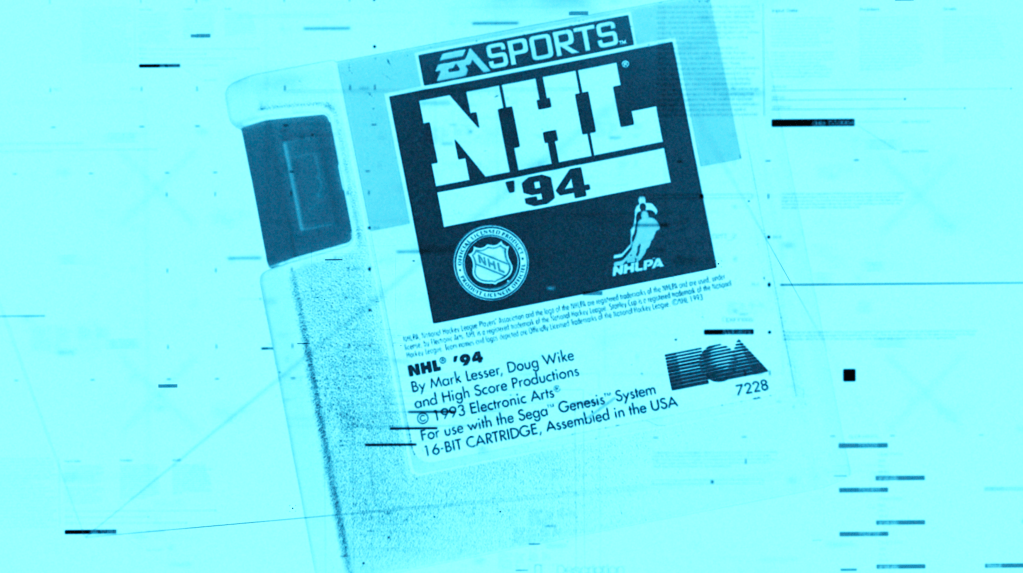
Released in 1993, NHL ‘94 quickly became more than just a hockey game, it became a cultural touchstone, a staple of living rooms, dorms, and tournaments. Its one-timers, glass-breaking, and flawless gameplay still captivate fans, while online leagues and retro tournaments prove its staying power. In today’s video, we’re taking a look back into the making of NHL ’94 , exploring how it combined innovation, fun, and authenticity to become the greatest hockey video game of all time, and why its legacy still endures even after more than 30 years.
From Football to Hockey
By the late 1980’s, Electronic Arts , also known as EA c, had already proven it could make a hit with sports video games. Released in 1988, John Madden Football brought the excitement of the NFL to consoles with intuitive controls, arcade-style gameplay, and the first taste of statistical realism. By the early 1990s, EA wanted to expand on the success they’d already had with sports video games, and hockey they realized could be the next frontier.
Their first attempt, the video game plainly titled “NHL Hockey”, released for the Sega Genesis in 1991, was simple but groundbreaking. Due to licensing issues with the NHLPA, the game was published without access to official player names. But the game still captured the essence of real NHL players. Team rosters were designed to reflect their real-life counterparts. For example, it was obvious that No. 99 on the Los Angeles Kings was Wayne Gretzky, even without the name being displayed. EA was able to obtain a license from the NHL however, so team names and logos were able to be included in the gameplay.
During development of the game, Michael Brook, producer of EA’s early hockey games, drew inspiration from the aggressive style of the Philadelphia Flyers of the mid 1970s, who were known as the Broad Street Bullies. Brook wanted fights, hits, and chaos—elements that would bring the arcade excitement of hockey into players’ living rooms. During early demonstrations at the 1991 Stanley Cup Final, reporters discovered that fights had been included in the game. Upon hearing of this, NHL officials demanded that fighting be removed from future versions, threatening to revoke the league license. Brook faced a choice: remove fighting and keep team logos, or keep fighting and lose the logos. In a somewhat surprising move, he chose gameplay over branding, and the fighting stayed.
With the success of NHL Hockey, EA released a follow-up game NHLPA Hockey ’93, just before the 1992-93 season. Notably absent were the team names and logos, best illustrated by the front cover, which had the New York Rangers logos removed from the players’ jerseys. Teams in the game were referred to by their city name, with the exception of the Islanders who were referred to as “Long Island”. As far as the gameplay, EA refined the experience, players could now control goalies, see blood on the ice, perform line changes, and enjoy faster player and goalie movement. While fighting was scaled back, it remained a thrilling part of gameplay.
Realism became increasingly important. Igor Kuperman, a former Winnipeg Jets executive, rated players in 12 categories, including shot accuracy, checking, passing, and fighting ability. Ratings were handwritten and painstakingly cross-referenced to be included in the game. NHL players even weighed in on their in-game representations, ensuring that stars, enforcers, and grinders all behaved authentically. NHLPA Hockey ’93 set a new standard for sports video games, blending authenticity with arcade fun and leaving future hockey games with a nearly impossible act to follow.
The Creation of NHL ’94
What’s amazing about the making of one of the most beloved hockey games of all time is that it came from a small team working out of a barn in Maine. Mark Lesser, the lead developer, openly admitted he knew very little about hockey when development began. To fill in the gaps, he hired a graphics artist for visuals and a sound engineer to digitize organ music. Despite their limited knowledge of the sport, or perhaps because of it, the team focused on creating a game that felt right rather than one that was a perfect simulation. Lesser emphasized player movement and momentum, giving each skater a sense of weight that mirrored real ice. Passing could be messy, goals could be chaotic, and players could easily skate past each other—capturing hockey’s beautiful unpredictability.
NHL ’94 kept the vertical camera angle that defined its series, offering strategic advantages over the side-view approach of other hockey games. It retained the 2D sprite models of NHLPA ’93, though with new animations, and featured rosters from the 1992–93 season. The game also included the NHL’s two newest expansion teams at the time, the Mighty Ducks of Anaheim and Florida Panthers.
EA consulted real coaches and players to add realism. Kings coach Barry Melrose and assistant Cap Raeder provided advice on hitting and fighting, while Kuperman’s ratings ensured stars and enforcers performed true to life. Lesser’s focus remained on gameplay physics: controlling player speed, puck movement, and smooth animations.
Last-minute negotiations with the NHL shaped the final product. Fighting was initially set to remain, but the league insisted on removing it in exchange for restoring official team logos. Lesser recalls spending time refining the fights only to have them cut, yet iconic features like the one-timer, glass-breaking, and fluid skating survived, becoming defining elements of the game for generations.
Several key innovations debuted in NHL ’94 . The one-timer allowed players to shoot directly off a pass, while manual goalie control gave gamers unprecedented precision. The game also let users save records and offered five modes: Exhibition Game, Stanley Cup Playoffs (single game and best-of-seven series), Shootout, and Demo. Though international teams were absent, both all-star squads were included. The game also introduced team-specific organ songs for goals and period starts, such as Hartford Whalers’ “Brass Bonanza,” St. Louis Blues’ “When the Saints Go Marching In,” and Chicago Blackhawks’ “Here Come the Hawks.”
When NHL ’94 launched in late 1993, it was met with critical acclaim and fan enthusiasm. The cover featured a Kings-Bruins matchup, immortalizing Andy Moog, Clark Donatelli, and Ray Bourque . Jeremy Roenick emerged as a video-game star; thanks to the Sega Genesis “weight bug,” his light frame made him an unstoppable force on ice. The end result of NHL’ 94 was a balance between authenticity and fun, which helped make the game an instant success.
Reception, Impact, and Legacy
Upon its release in September of 1993, NHL ’94 was universally praised by critics. Computer Gaming World called the DOS version “a playing environment flush with realism, excitement and credibility,” noting that players would feel like they were in control of a televised NHL broadcast. By June 1994, the game was a finalist for the magazine’s Sports Game of the Year award. GamePro gave the Sega CD version a perfect score, highlighting improved controls, playability, and real-life NHL footage. Allgame editor Scott Alan Marriott described it as “the best playing hockey game at the time of its release.” And GamesMaster later ranked the Mega Drive version 65th in its “Top 100 Games of All Time.” Commercially, NHL ’94 was a hit, outselling Madden 93 and selling over a million copies. A Japanese Super Famicom version, NHL Pro Hockey ’94, was released with localized menus and text but retained all of the familiar gameplay.
Over the years, NHL ’94 has influenced countless other titles. EA’s Sega Genesis game Mutant League Hockey used a modified version of its engine, while the Genesis version was also included in NHL 06 on PlayStation 2 , though due to licensing issues EA replaced the team rosters with fake players and changed the Hartford Whalers to the “Hartford Canes”. The game has been celebrated in modern EA Sports titles: NHL 14 featured an NHL ’94 Anniversary Mode, bringing the classic gameplay, music, and fast-paced action into the 2013-14 NHL season. This mode returned in NHL 15 and NHL: Legacy Edition. In 2020, a port called NHL ’94 Rewind was released for PS4 and Xbox One, emulating the Genesis version but featuring the 2020-21 NHL rosters.
NHL ’94 has become more than just a video game; it is a cultural touchstone for hockey fans and gamers alike. From its groundbreaking gameplay, including the iconic one-timer, fluid skating, and strategic depth, to its attention to team rosters, player abilities, and authentic organ music, the game set a standard that few sports titles have matched. Its critical acclaim, commercial success, and lasting influence on future hockey games—from Mutant League Hockey to modern EA Sports titles—demonstrate its enduring impact. With ports, anniversary modes, and re-releases keeping it relevant across decades, NHL ’94 has transcended generations of gamers. Its recognition by critics and fans cements its status as a defining moment in sports gaming. Ultimately, NHL ’94’s blend of realism, accessibility, and sheer fun ensures its place as a timeless classic in video game history.
In 2013, ESPN ranked NHL ‘94 the second best sports video game of all time, and Bleacher Report gave the game the number one spot on their list of all time hockey video games. Do you agree with their rankings? Would you put NHL ‘94 at the top of your list, or do you believe another game deserves that title?
Also, if there’s anything about what makes NHL ‘94 special that I forgot to mention in this video, let me know in the comments below!
If you’ve enjoyed this post, check out my article on Tecmo Super Bowl, where I go deeper into the development and the cultural impact that Tecmo Super Bowl still holds today. As always, please like and subscribe if you haven’t already, and thanks for reading!
 All Sports History
Leave a comment