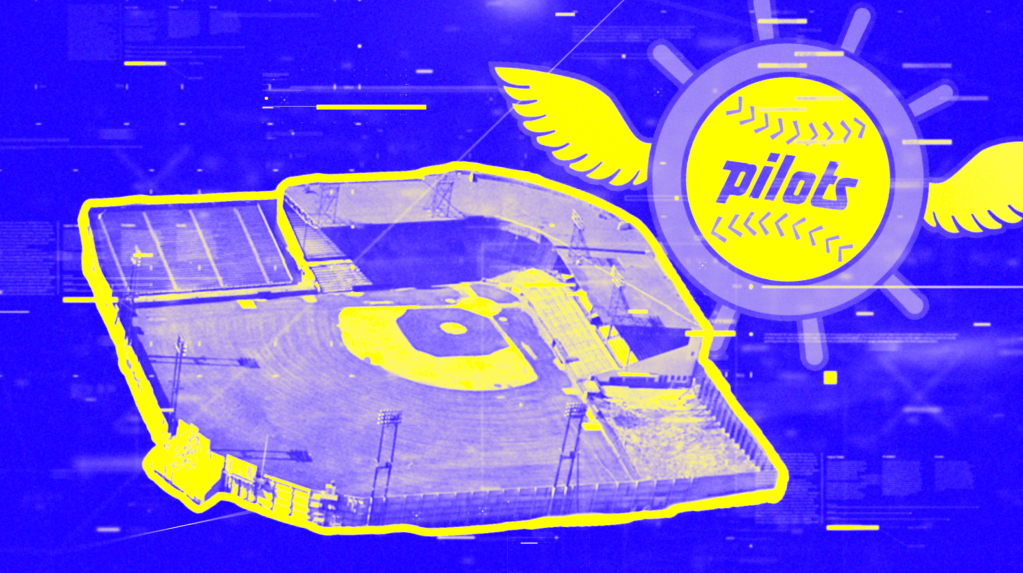
Sick’s Stadium was once a proud symbol of Seattle’s baseball ambitions—a ballpark that not only energized a city but finally helped bring Major League Baseball to the Pacific Northwest. Yet just as quickly as it rose to prominence, it faded from memory, overshadowed by bigger dreams and a new era of sports in Seattle. This is the story of how a stadium that stood for nearly 40 years, hosted legends and heartbreak alike, and helped shape Seattle’s baseball identity—until the stadium was ultimately demolished.
The Early Years
The story of Sick’s Stadium truly began with a minor league baseball team that would capture local hearts for decades—the Seattle Rainiers. Originally known as the Clamdiggers, the team was formed in 1903 and played in the Pacific Coast League (also known as the PCL). Unfortunately, the PCL contracted from six teams to four after the 1906 season due to financial instability. This forced the Clamdiggers to join the Northwestern League, where they would undergo several team changes over the next decade. In 1919, the team returned to the PCL under a new name—the Seattle Indians. They played their home games at Dugdale Field, a ballpark built in 1913 in the Rainier Valley neighborhood. For years, the Indians were a fixture in the PCL, though they rarely found consistent success on the field. That changed dramatically in the late 1930s. In 1932, tragedy struck when Dugdale Field burned to the ground on Independence Day. The blaze was the work of serial arsonist Robert Driscoll, who was later described by authorities as one of the most dangerous arsonists in the United States during the Great Depression. With their home destroyed, the Indians were forced to play temporarily at Civic Field, a converted football stadium at the site where Seattle Center’s Memorial Stadium stood until 2025. After several years of uncertainty, a new era began when local businessman Emil Sick—the owner of Rainier Brewing Company—purchased the struggling franchise in 1938. Sick immediately set out to transform both the team and its image. He rebranded the Seattle Indians as the Seattle Rainiers, paying homage to his brewery’s famous brand, and began investing heavily in the team’s facilities and future.
Sick also financed the construction of a brand-new ballpark on the site of the old Dugdale Field. The new stadium, named Sick’s Stadium, officially opened on June 15, 1938, with a seating capacity of about 15,000. Its field alignment ran southeast from home plate to center field, which unfortunately caused difficult visibility conditions for left-side defenders during early evening games. The Rainiers quickly became a powerhouse in the Pacific Coast League, winning five league titles between the early 1940s and mid-1950s. In 1946, Sick’s Stadium also briefly hosted the Seattle Steelheads—a Negro League team that played in the short-lived West Coast Negro Baseball Association. The Steelheads shared the stadium with the Rainiers, taking the field whenever the Rainiers were on the road. The Steelheads also played home games in Tacoma, Bremerton, Spokane, and Bellingham. Though the league itself lasted only one season, it marked an important chapter in Seattle’s diverse baseball history.
As the years went on, however, the Rainiers’ dominance began to fade. After a string of lackluster seasons in the late 1950s, Emil Sick decided to sell the team. In 1960, the Rainiers were purchased by the Boston Red Sox, becoming the club’s Triple-A affiliate. Four years later, the team was sold again—this time to the Los Angeles Angels—and renamed the Seattle Angels. By this time, professional baseball was changing rapidly. Major League Baseball had finally reached the West Coast in 1958, when the Brooklyn Dodgers and New York Giants moved to Los Angeles and San Francisco, respectively. Their success completely reshaped the sport’s geography—and its economics. The Pacific Coast League, which had once dreamed of becoming a third major league, began to lose its prestige. For the next decade, MLB teams frequently used relocation threats to pressure cities into building new stadiums, often dangling the possibility of moving west as leverage.
MLB Comes To Seattle
By the early to mid-1960s, Seattle was one of the largest U.S. cities without a major professional sports team. It was the third-largest metropolitan area in the western United States, and civic leaders saw baseball as key to establishing Seattle’s identity on the national stage. In 1964, the Cleveland Indians became the first MLB team to seriously consider relocating to Seattle. Team owner William R. Daley even visited the city to scout potential stadium sites. But after touring Sick’s Stadium, Daley declared that the ballpark wasn’t suitable for a major league club—it would need to be expanded to at least 25,000 seats just to be considered a temporary home. Meanwhile, Emil Sick, the stadium’s namesake, had passed away, and ownership of Sick’s Stadium transferred to his family. In a curious twist, the City of Seattle had been purchasing land around the same area for future Interstate 5 expansion. In 1965, the city purchased the Sick’s Stadium property from the Sick family for $1.15 million, assuming it might eventually be used for the freeway project. Those freeway plans never materialized, and the city found itself as the reluctant owner of a now-aging baseball park. With no major league tenant in sight, Sick’s Stadium began to fall into disrepair. Daley and the Indians, meanwhile, decided to stay in Cleveland after negotiating more favorable lease terms at Municipal Stadium. Just a few years later, in 1967, another team—the Kansas City Athletics—also explored relocating to Seattle. Owner Charlie Finley visited the city and toured Sick’s Stadium, but he too came away unimpressed, joking that the small, outdated ballpark “lived up to its name.” Instead, Finley moved the franchise to Oakland, where they became the Oakland Athletics in 1968.
After being rejected twice by potential relocations, Seattle shifted its focus toward landing an MLB expansion franchise. During the 1967 owners’ meetings in Mexico City, Washington senators Henry “Scoop” Jackson and Warren Magnuson lobbied heavily on the city’s behalf. Magnuson, who chaired the Senate Commerce Committee overseeing MLB’s business affairs, wielded significant influence over team owners. Originally, MLB owners didn’t plan to expand until 1971, but political pressure—especially from Missouri Senator Stuart Symington, still furious about the Athletics leaving Kansas City—pushed them to accelerate the timeline. Expansion was moved up to the 1969 season, with four new franchises added: Montreal and San Diego in the National League, and Kansas City and Seattle in the American League. The Seattle ownership group, Pacific Northwest Sports, Inc., was led by brothers Dewey and Max Soriano. Dewey, a former Rainiers pitcher and PCL executive, chose the nickname Seattle Pilots to honor the city’s aviation and maritime heritage. The team colors were royal blue, gold, and white, featuring a block “S” logo. To fund the expansion costs, Dewey Soriano turned to an old acquaintance—William Daley, the same former Indians owner who once considered moving his team to Seattle. Daley agreed to help finance the franchise in exchange for a 47% ownership stake, making him a co-owner of the new Seattle Pilots. The Pilots were also required to pay the PCL $1 million in compensation for the loss of the Rainiers franchise, which folded shortly after Seattle’s MLB expansion was announced.
The only major obstacle left was finding a proper stadium. MLB owners were still skeptical about Sick’s Stadium’s size and condition, but Seattle promised it could be renovated quickly—expanded to 30,000 seats in just five months—to serve as a temporary home until a new multipurpose domed stadium could be built. On February 13, 1968, voters in King County, Washington, approved $40 million in bonds to construct that new domed facility—an early precursor to what would eventually become the Kingdome. It was the end of the Rainiers’ long journey and the beginning of Seattle’s major league dream. Sick’s Stadium, once built for a minor league team, would soon host big-league baseball.
Becoming a Major League Ballpark
The Pilots’ debut game came on April 8, 1969, in Anaheim, where they defeated the California Angels 4–3. A few days later, on April 11, they played their first home game at Sick’s Stadium, beating the Chicago White Sox 7–0. For a brief moment, the excitement drowned out the smell of fresh paint and the sound of construction equipment still humming outside the gates. Heading into the season, the team’s front office optimistically believed they could finish near the middle of their division, the American League West. They won three of their first four games, but things unraveled quickly. Long losing streaks in July and August—one of eight games, another of ten—sent them tumbling to the bottom of the standings. By season’s end, Seattle had 64 wins and 98 losses, finishing 33 games behind the division-winning Minnesota Twins. They ranked second-to-last in the American League, ahead of only Cleveland. On the bright side, they fared slightly better than the National League’s new expansion clubs, the Montreal Expos and San Diego Padres, both of whom lost 110 games. Unfortunately, the on-field product wasn’t the Pilots’ biggest problem—the stadium was. Sick’s Stadium’s shortcomings became a national embarrassment. Newspapers mocked it as “a pigsty” (a phrase first used by Athletics owner Charlie Finley when he scouted it in 1967) and fans grew increasingly frustrated with the lack of amenities. The Pilots drew 677,944 fans in their only season, ranking 20th out of 24 teams—barely better than San Diego among the four expansion franchises. Despite the poor fan experience, ticket prices were among the highest in baseball, further alienating supporters. With weak attendance, enormous stadium costs, and ballooning debt, the team bled money. By the end of 1969, it was clear that Sick’s Stadium could no longer serve as even a temporary home.
The team’s ownership group, Pacific Northwest Sports, Inc., had hoped the domed stadium approved by voters in 1968 would be under construction by the time the Pilots finished their inaugural season. But the project hit a massive roadblock. The proposed site—on the former 1962 World’s Fair grounds—faced fierce opposition from preservation groups. Legal challenges and petitions froze the project before a single shovel hit the ground. Without a new stadium, and with Sick’s Stadium falling apart, the team had nowhere to go. Financially, they were collapsing. Majority owner Dewey Soriano was running out of money, and his largest investor, William Daley (ironically, the same man who once considered moving his Cleveland Indians to Seattle), refused to contribute more funds, which put the future of the Pilots franchise in major jeopardy.
The Move To Milwaukee
Desperate to keep the franchise alive, Soriano began searching for a buyer. One of the first potential saviors was Bud Selig, a Milwaukee car dealer and former minority owner of the Milwaukee Braves. Ever since the Braves had moved to Atlanta in 1966, Selig had been determined to bring Major League Baseball back to Milwaukee. To prove the city could still support a team, Selig organized exhibition games at Milwaukee County Stadium between 1967 and 1968. One matchup between the White Sox and Twins drew 51,000 fans, and the turnout was so strong that White Sox owner Arthur Allyn began hosting several “home” games in Milwaukee. In 1969, those games accounted for nearly a third of Chicago’s total attendance. After MLB’s 1969 expansion passed Milwaukee by, Selig turned his attention to buying an existing franchise. He tried to buy the White Sox outright, but the league vetoed the deal. When word spread that the Seattle Pilots were in financial trouble, Selig saw his chance. On October 11, 1969, Soriano and Selig agreed in principle to sell the Pilots for $13.1 million, with the understanding that Selig would relocate them to Milwaukee. But Washington’s political establishment quickly mobilized to stop it. Senators Warren Magnuson and Henry “Scoop” Jackson, along with Attorney General Slade Gorton, pressured MLB to reject the sale.
Other potential buyers emerged, including Fred Danz, a regional movie theater chain owner who admitted he wasn’t a baseball fan but felt the city needed to keep its team. Danz offered $10 million, but the deal collapsed when the team’s main creditor, the Bank of California, demanded immediate repayment of a $3.5 million loan. Another proposal came from Eddie Carlson, head of Westin Hotels and the visionary behind Seattle’s Space Needle, who led a nonprofit group to keep the team locally owned. But the American League’s other owners rejected the idea outright, arguing that public ownership would devalue their franchises. With every rescue attempt failing, bankruptcy became inevitable.
On March 16, 1970, just weeks before Opening Day, the State of Washington obtained an injunction to halt the sale to Selig. But the Pilots were broke. The Pilot’s general manager, Marvin Milkes admitted during hearings that the team couldn’t pay players, coaches, or staff—and if player paychecks were delayed even ten days, they’d all become free agents. On April 1, 1970, a federal judge officially declared the Seattle Pilots bankrupt, clearing the way for the sale to Selig’s Milwaukee group. The team’s equipment sat in moving trucks in Provo, Utah, waiting for word on where to go—Seattle or Milwaukee. When the ruling came, the trucks drove east. The Seattle Pilots were no more.
Within days, the franchise was reborn as the Milwaukee Brewers, named after the city’s historic connection to beer brewing. The move happened so late that Selig couldn’t even change the uniforms in time for Opening Day. The new Brewers simply removed the Pilots’ logos and patches, keeping the same royal blue and gold colors—a palette that still defines the team today. The Brewers’ simple block “M” logo was used from 1970 to 1977, before being replaced by the now-iconic ball-and-glove “MB” logo in 1978, designed by art student Tom Meindel.
After The Pilots Left
When the Seattle Pilots packed their bags for Milwaukee in the spring of 1970, they left behind more than an empty ballpark. They left behind a city embarrassed, angry, and determined to prove it still deserved Major League Baseball. But in the years that followed, as lawsuits dragged on and new stadium plans took shape, Sick’s Stadium lingered in a strange twilight—half-forgotten, half-revived, and ultimately reclaimed by time.The departure of the Pilots sparked outrage across Washington. Almost immediately, the City of Seattle, King County, and the State of Washington filed a $32.5 million lawsuit against the American League, claiming that the owners had breached their contract by allowing the franchise to be moved. The lawsuit dragged on for six years, with both sides entrenched. The city argued that it had been promised a stable team, and had already invested heavily in stadium expansion and future infrastructure. The league countered that Seattle had failed to provide an adequate ballpark or ownership group capable of sustaining a major league franchise. For years, the dispute hung in limbo—until a compromise was finally reached in 1976. The American League agreed to award Seattle a new expansion franchise if the lawsuit was dropped. The deal not only ended one of the most unusual legal sagas in baseball history, but it also laid the groundwork for the return of professional baseball to Seattle.
Even while the lawsuit wound its way through the courts, local officials never stopped dreaming of a proper stadium—one that would ensure Seattle would never again lose a team because of inadequate facilities.In 1970, King County revived plans for a domed stadium that had been stalled since the Pilots’ collapse. A special commission spent nearly two years studying the best site for the project, ultimately recommending a location near King Street Station, just south of downtown. In late 1971, the King County Council voted 8–1 to approve the site. One year later, on November 2, 1972, officials gathered for a ceremonial groundbreaking. The design called for a multi-purpose facility that could seat nearly 60,000 for baseball and 66,000 for football. Owned by the county, it was simply named the Kingdome. The Kingdome was envisioned as a civic monument—a bold, futuristic answer to the dilapidated Sick’s Stadium. But the project wasn’t without turbulence. The original contractor made costly errors that delayed construction and ballooned expenses. Despite the setbacks, after nearly four years of work, the Kingdome officially opened on March 27, 1976.
By the time the Kingdome opened, Seattle had already made its next big play: securing an NFL expansion franchise. In 1974, a coalition of local business and civic leaders calling themselves Seattle Professional Football, Inc., successfully lobbied the National Football League to award the city a new team. Two years later, on September 12, 1976, the Seattle Seahawks played their first regular-season game at the Kingdome, facing the St. Louis Cardinals before a crowd of more than 58,000 fans.
Just months earlier, in January 1976, the American League had formally approved Seattle’s new baseball team as its 13th franchise. The announcement came as both vindication and relief for a city that had waited seven long years to rejoin the majors. Later that summer, the new club unveiled its name—the Seattle Mariners—chosen from a fan contest. The branding subtly nodded to the Pilots of old: a blue-and-gold color scheme and a trident-shaped “M” logo that pointed downward like an anchor. The Mariners debuted at the Kingdome on April 6, 1977, in a 7–0 loss to the California Angels. While the Pilots’ one-year flameout had become a punchline, the Mariners’ arrival felt like redemption. Seattle had reclaimed its place in the big leagues, this time in a stadium that finally met major league standards.
The End For Sick’s Stadium
But as the Kingdome rose, Sick’s Stadium slipped quietly into decay. With the Pilots gone, the ballpark sat largely unused in the early 1970s—its paint peeling, its stands crumbling, its locker rooms long since stripped of plumbing and fixtures. Yet baseball refused to vanish completely. In 1972, a new Seattle Rainiers team was established, playing in the Class A Northwest League. It was a nod to history—the Rainiers had once been Seattle’s beloved minor league team before the Pilots—and it offered a modest way to keep the game alive while the city awaited its next big-league shot. From 1972 to 1976, the new Rainiers played summer ball at Sick’s, usually in front of sparse crowds. On September 1, 1976, the final professional baseball game ever played there ended poetically: local pitcher George Meyring (MY-RING) threw a 2–0 shutout against the Portland Mavericks. It was a quiet farewell to the park that had once symbolized Seattle’s baseball ambitions. Sick’s Stadium also served one more temporary purpose. During 1973, the University of Washington Huskies baseball team used the venue while their own field, Graves Field, underwent renovation. But after that, the old park’s days as a functional ballpark were numbered.
In the years immediately following its closure, Sick’s Stadium was slowly dismantled, piece by piece. In 1978, the park’s primary physical assets—bleachers, fencing, foul poles, and lighting—were auctioned off. The bulk of it was purchased by Harry Ornest, the owner of the new Vancouver Canadians, who spent $60,000 to install the materials at Nat Bailey Stadium in Vancouver, British Columbia. Other pieces scattered farther afield. In 1979, Washington State University bought several sets of bleachers, fencing, and foul poles for the construction of Buck Bailey Field in Pullman. The fit wasn’t perfect, and the bleachers were eventually resold. A few dozen of Sick’s original box seats made the longest trip of all—transported to Growden Memorial Park in Fairbanks, Alaska, where they remain in use today for collegiate summer league baseball. The demolition of Sick’s Stadium began in 1979, bringing an end to the park’s 41-year run. For nearly two decades afterward, the site sat empty, overgrown and unremarkable. Then, in 1992, the land was redeveloped into an Eagle Hardware & Garden store, which later became a Lowe’s in 1999. But traces of the ballpark remain. A historic marker at the corner of Rainier Avenue and McClellan Street commemorates the site, and inside the store, the layout subtly honors its baseball past:
- A replica home plate sits near the store’s exit.
- The locations of the bases are outlined on the floor.
- A circular marker near the cash registers marks where the pitcher’s mound once stood—exactly 60 feet, 6 inches from home plate.
- A display case holds mementos from the Pilots, Rainiers, and Seattle Angels, preserving the memory of the teams that once called the site home.
By the time the Mariners took the field in 1977, Sick’s Stadium had already faded into nostalgia. The Kingdome symbolized the future—massive, modern, and civic-minded—while Sick’s stood as a relic of the past, a reminder of what had gone wrong the first time around. Yet, for all its flaws, Sick’s Stadium remains an essential part of Seattle’s baseball identity. It represented the city’s first true attempt to step onto the national stage, however brief or chaotic that attempt may have been. And though it fell apart, it set in motion the events that led to Seattle becoming a permanent part of the major leagues. Even today, when fans walk through that Lowe’s on Rainier Avenue and glance down at the small plaque near the registers, they’re standing in the ghost of the pitcher’s mound. The echoes of that single, tumultuous year—and of every minor leaguer and fan who came before—still linger there. Sick’s Stadium may be gone, but its story continues to shape Seattle baseball history, from the Pilots’ heartbreak to the Mariners’ rebirth.
Over more than 150 years of MLB history, plenty of ballparks have come and gone — and many have been mostly forgotten. Places like Exhibition Stadium in Toronto, League Park in Cleveland, Griffith Stadium in Washington D.C., and the Montreal Expos’ old home at Jarry Park. Sick’s Stadium in Seattle is right up there with them, holding a unique spot among baseball’s lost parks. So where would you rank Sick’s Stadium on the list of all-time forgotten MLB ballparks? Is it number one? Or does it not even make your list? Let me know in the comments below!
If you’ve enjoyed this article, check out my post on the full history of the Seattle Pilots. Where we go deeper into the amazing story of the Pilots’ one and done season in Seattle. As always please like and subscribe if you haven’t already, and thanks for reading!
 All Sports History
Leave a comment