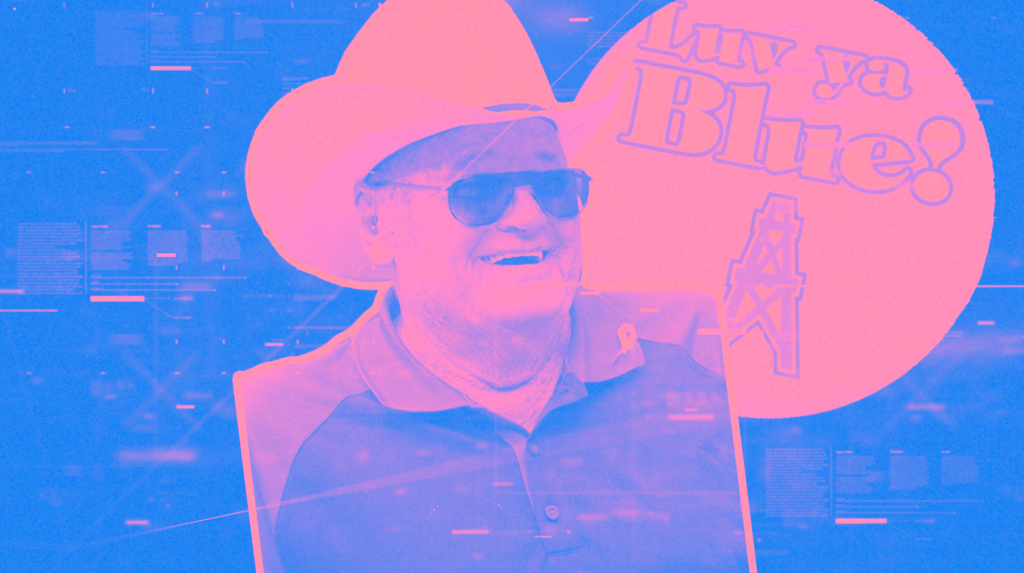
In the late 1970s, Houston wasn’t just a football town—it was Oilers country. Led by the larger-than-life Bum Phillips and the unstoppable Earl Campbell, the “Luv Ya Blue” era turned the Astrodome into a madhouse and gave Houston fans hope like never before. But just as quickly as the magic arrived, it was gone, undone by front office decisions, playoff heartbreak, and a shocking firing that changed everything. This is the story of the team Houston fell in love with… and how it all slipped away.
In 1965, a brand new domed stadium called the “Astrodome” opened its doors for the first time. The Astrodome was dubbed the world’s first multi-purpose domed venue and was nicknamed the “eighth wonder of the world” for its space age look and special use of synthetic turf, nicknamed “Astroturf”. At the time, it was widely expected that the Houston Oilers would move in and play at the Astrodome. Prior to that, the team had played at the University of Houston from 1960 to 64 and Rice University from 1965 to 67. But, negotiations between Adams and Roy Hofheinz, the owner of the Houston Astros and the Astrodome, did not go well initially. Adams was notoriously tight-fisted when it came to team finances, and preferred to cut costs wherever he could to offset the highest paid players salaries on the Oilers’ team payroll.
Eventually by 1968, Bud Adams and Roy Hofheniz came to an agreement and the Houston Oilers became the first football team to play in a domed stadium when they moved into the Astrodome (which became their home for the next 28 years). By the mid 1960’s, the AFL had firmly established itself as a real threat to the NFL’s dominance and in 1966 it was officially announced that the two leagues would merge. After the merger, Houston would struggle in the standings finishing last place in the AFC central division for four straight seasons between 1970 and 1973. The team’s fortunes would begin to change around the mid to late 1970’s, with the arrival of charismatic head coach Bum Phillps, Billy “White Shoes” Johnson, and future hall of farmers Elvin Bethea and Earl Campbell. This core group became a sensation in Houston and would usher in a new era of Oilers’ football dubbed, “Luv Yah Blue”. Earl Campbell would go on to win rookie of the year, and would help the Oilers make the AFC championship game two years in a row in 1978 and 1979. However, the Oilers were defeated both times by the eventual Super Bowl winners the Pittsburgh Steelers.
The following year, the Oilers made the playoffs once more but disappointingly were eliminated in the Wild Card game against the Oakland Raiders. In another controversial move by Bud Adams, immediately following the playoff loss to the Raiders, head coach Bum Phillips was fired. The move was made despite Phillips coaching the Oilers to another winning 11-5 season and leading the team through their most successful era since joining the NFL. The reported reason for Phillips’ firing was because he failed to hire an offensive coordinator but also allegedly due to his failure to report a player’s recreational drug use until after the season had ended. The change of leadership didn’t not help and things after that quickly began to spiral downward.
The next few seasons would be disastrous for the team, who only won 13 games over the span of four seasons. Some of that was in part due to a strike shortened season in 1982, but the team also disappointedly struggled to build on the AFC championship runs from just a few years prior. Fan favorite Earl Cambell had become frustrated with his reduced playing time, and demanded to be traded towards the end of the 1983 season. After the Oilers lost the first six games of the next season, Campbell was traded to the New Orleans Saints for a first round draft pick. With Bum Phillips and Earl Campbell’s departures, it effectively ended the Luv Yah Blue era for the Oilers.
Relocation
During the Oilers struggles throughout the 1980s, Bud Adams continued to grow increasingly frustrated with the team’s stadium situation. By the mid 1980’s, Bud Adams actually threatened to move the team to Jacksonville Florida if the Astrodome wasn’t brought up to date with new renovations. Harris County, where the Astrodome is located, offered to pay for improvements to the aging stadium. At the time, the venue only seated 50,000 fans, which was the smallest capacity in the NFL. The funds would be paid for through mostly tax increases on properties and hotels. However, Adams had further demands on improvements, which ballooned the estimated cost of renovations to 67 million dollars. The back and forth over the final cost of the renovations would create lasting tension between the Oilers and the city of Houston that would foreshadow an even bigger fight in the coming years.
By the end of 1993, even with the improvements to the Astrodome just six years prior, Bud Adams continued to threaten to leave Houston if no new stadium deal could be agreed upon. The city of Houston had no interest in spending more money to build a new stadium after the most recent costly renovations. Also, Houston was in a tough position because all of it’s major sports franchises, the Houston Oilers, Astros and Rockets, were in need of new stadiums and arenas during this time. Bud Adams had the idea of building a new domed multipurpose stadium that could also be the home for the Rockets, similar to the Alamo dome in San Antonio with the Spurs. He even offered to pay 25 percent of the building costs, but after some time trying to convince the mayor of Houston Bob Lanier to publicly support the plan, Adams realized he needed to start looking elsewhere.
A secret meeting was then set up between Nashville’s mayor Phil Bredsen and Bud Adams about potentially relocating to Tennessee. The city of Nashiville even offered to pay 144 million towards building a new stadium plus another 70 million to cover ticket sales. With this enticing offer, and the lack of momentum for a new stadium in Houston, it became clear that Bud Adams wasn’t going to get the funding necessary to build a new stadium in Houston. With that, it was revealed during the 1995 season that the Oilers would be officially moving to Nashville, Tennessee for the 1998 season. Once the announcement was made, fans in Houston understandably had little interest in supporting the Oilers anymore. Not surprisingly, ticket sales for the 1996 season tanked, with the team attracting more than 30,000 fans only three times that season.
The last home game of the 1996 season, on December 15, attracted the smallest attendance in franchise history with just over 15,000 fans showing up. The league had to step in due to ticket sales plummeting, and an NFL blackout rule that prevented fans in the local market from even watching Oilers games at home due to them not being sellouts. Bud Adams and NFL reached an agreement with Houston to be let out of their lease a year early so that they could move to Nashville. However, Nashville wasn’t ready for the Oilers to move in just yet. They were still constructing the stadium that would be their new home, and the largest football stadium at that time in Nashville was Vanderbelt stadium that only seated 41,000. Bud Adams then made the decision to play in Memphis, Tennessee at the Liberty Bowl Memorial Stadium for the 1997 and 1998 seasons.
After moving to Memphis, the Tennessee Oilers faced the same problem they had in Houston, empty stadiums and disinterested fans. Even a nearly full crowd against the Steelers in 1997 turned out to be mostly Pittsburgh fans, embarrassing owner Bud Adams into relocating again, this time to Vanderbilt’s stadium in Nashville. In 1999, they became the Tennessee Titans. Despite holding onto the Oilers’ history, the NFL retired the name, preventing its return to Houston. For fans of the Luv Ya Blue era, it was a bitter end to a team that once captured the city’s heart.
Speaking of the Luv Ya Blue era, back in September of 2023, The University of Houston debuted Columbia-blue “Luv Ya Blue” throwback uniforms as a tribute to the iconic Houston Oilers. While the homage struck a chord with fans, the NFL’s merchandising and licensing division sent a cease-and-desist letter, arguing the design infringes on the Oilers’ trademark by too closely mirroring sleeve stripes, colors, and script. The university maintained that the uniforms honored what they called “H‑Town pride,” but the NFL demanded a halt to production, sales, and promotion. The letter emphasized that UH’s usage could mislead consumers into believing there was an official NFL affiliation. Recently, UH made slight design changes but kept the color scheme, arguing it’s tied to Houston’s identity, not just the Oilers. Despite the warning, UH plans to keep the uniforms in rotation, and it remains unclear if the NFL will escalate things further or back off after the adjustments.
So that brings me to this question, do you think the NFL is right to go after the University of Houston over the “Luv Ya Blue” uniforms—or should UH be allowed to honor the city’s football history however they want?
If you enjoyed this post, check out my article on the full history of the Houston Oilers franchise. Where I go deeper into the rise, fall, and relocation of the team that once called Houston home. As always please like and subscribe if you haven’t already, and thanks for watching!
 All Sports History
Leave a comment