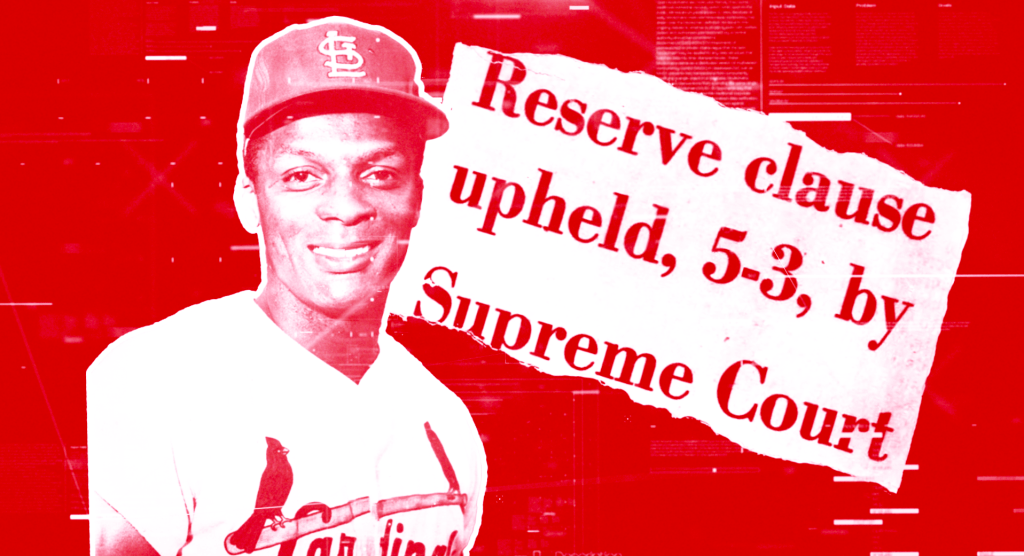
On this day in sports history in 1972, The US Supreme Court in a 5-3 decision, upheld an earlier ruling by a lower court which protected Major League Baseball from antitrust laws in a case involving former St. Louis Cardinal player Curt Flood. Flood had sought to challenge MLB’s “reserve clause” which bound players to their teams indefinitely, preventing them from negotiating contracts with other teams or becoming free agents. This system gave all the power to the owners, leaving players with limited control over their careers.
Flood, an exceptional center fielder for the St. Louis Cardinals, became increasingly frustrated with the reserve clause and the lack of control it afforded players. In 1969, he made the bold decision to challenge the clause after being traded to the Philadelphia Phillies without his consent. Flood’s courageous stance marked the beginning of a legal battle that would shape the future of professional sports. He decided to sue the then commissioner of baseball, Bowie Kuhn for $1 million in an antitrust case. Flood’s challenge went all the way to the United States Supreme Court in the case of Flood v. Kuhn. Although Flood ultimately lost the case, his efforts brought attention to the injustices of the reserve clause system. His willingness to sacrifice his career and challenge the status quo set a precedent for future athletes to fight for their rights.
After being traded in 1969, and deciding to challenge MLB, Flood’s baseball career was essentially over at that point. He never reported to the Phillies after the trade, and later decided to sit out the entire 1970 season. The Phillies realizing Flood was never going to play for them, got two minor leaguers from the Cardinals instead, and in November of 1970 traded Flood to the Washington Senators. Flood wanted to resume his playing career, but knew it would be difficult due to the amount of hate mail he received from fans claiming that he was trying to “destroy baseball” and being nearly blackballed from the sport by the owners. Flood signed a new contract with the Senators for $100,000, but after only 13 games into the 1971 season he struggled hitting .200 and wasn’t faring much better defensively in the field. Flood decided to retire on April 25, 1971, cutting short a once promising career.
The impact of Flood’s challenge was not immediate, but it laid the groundwork for change. In 1975, after a series of collective bargaining negotiations, the reserve clause was effectively overturned. The Seitz decision, as it became known, was a landmark ruling that played a pivotal role in reshaping the landscape of professional sports. The decision came as a result of an arbitration case involving the Major League Baseball Players Association (MLBPA) and the owners of the league. It was named after the arbitrator, Peter Seitz, who presided over the case. At the heart of the Seitz decision was the issue of player contracts and the interpretation of the reserve clause. The reserve clause had long been used to bind players to their teams indefinitely, granting owners complete control over player movement and contracts. However, Seitz ruled in favor of the players, declaring that the reserve clause was not enforceable and effectively ended its reign.
The Seitz decision marked a turning point in the relationship between players and team owners. It opened the door for players to become free agents and negotiate contracts with other teams, ultimately leading to the establishment of free agency in professional sports. This newfound freedom gave players the ability to choose their teams and secure more favorable terms in their contracts. The Seitz decision had far-reaching implications not only in baseball but also in other sports, as it set a precedent for challenging restrictive player contracts and promoting the rights of athletes. Flood’s actions paved the way for future legal battles that would further dismantle restrictive player contracts, and his challenge was a catalyst for change, pushing the sports industry to reevaluate the balance of power between owners and athletes.
The significance of Flood’s challenge extended beyond the world of baseball. His fight for player rights and freedom of movement resonated with athletes in other sports, leading to similar battles in football, basketball, and beyond. The collective efforts of these athletes have since reshaped the sports landscape, creating a more equitable and player-friendly system. Flood’s challenge also highlighted the racial inequities present in professional sports at the time. As an African American player, he faced additional barriers and discrimination in his pursuit of justice. His fight for the rights of all players, regardless of race, played a crucial role in advancing equality within the sports industry.
The Curt Flood Act of 1998, named in honor of the legendary baseball player, marked another significant milestone in the ongoing struggle for player rights. The act was enacted to address the unfair treatment of professional athletes and provide them with certain legal protections. It aimed to level the playing field between athletes and team owners by exempting the business of professional baseball from certain antitrust laws. The Curt Flood Act sought to correct the perceived injustice of that ruling by granting professional baseball players the same antitrust rights enjoyed by workers in other industries. It aimed to ensure that players were not subject to unfair and monopolistic practices by team owners and league officials.
By exempting professional baseball from antitrust laws, the Curt Flood Act provided players with more leverage in contract negotiations and allowed for a fairer marketplace. It empowered athletes to challenge restrictive practices and seek better compensation and working conditions. The act represented a significant step forward in recognizing the rights and agency of professional athletes, and it further solidified Curt Flood’s legacy as a pioneer in the fight for player rights.
Curt Flood’s legacy as a trailblazer cannot be overstated. His challenge to the reserve clause initiated a movement that forever changed the relationship between athletes and team ownership. Today, players enjoy greater autonomy and control over their careers, thanks in part to Flood’s determination and sacrifice. Flood’s impact on baseball was recognized posthumously, as he was inducted into the St. Louis Cardinals Hall of Fame and the African American Athletes Hall of Fame. His contributions to the sport and the rights of athletes continue to be celebrated and honored.
In conclusion, Curt Flood’s challenge to the reserve clause was a landmark moment in the history of professional sports. His actions sparked a legal battle and a larger movement that ultimately led to the dismantling of the reserve clause and the introduction of free agency. Flood’s courage and advocacy for player rights set a precedent for future athletes, reshaping the sports industry and granting players greater control over their careers. His legacy as a trailblazer and advocate for justice will forever be remembered in the annals of sports history.
 All Sports History
Leave a comment